






Survey Finds 62% of Americans Believe Buying a Home in 2026 is Unrealistic
Fewer People Now See Homeownership as the American Dream
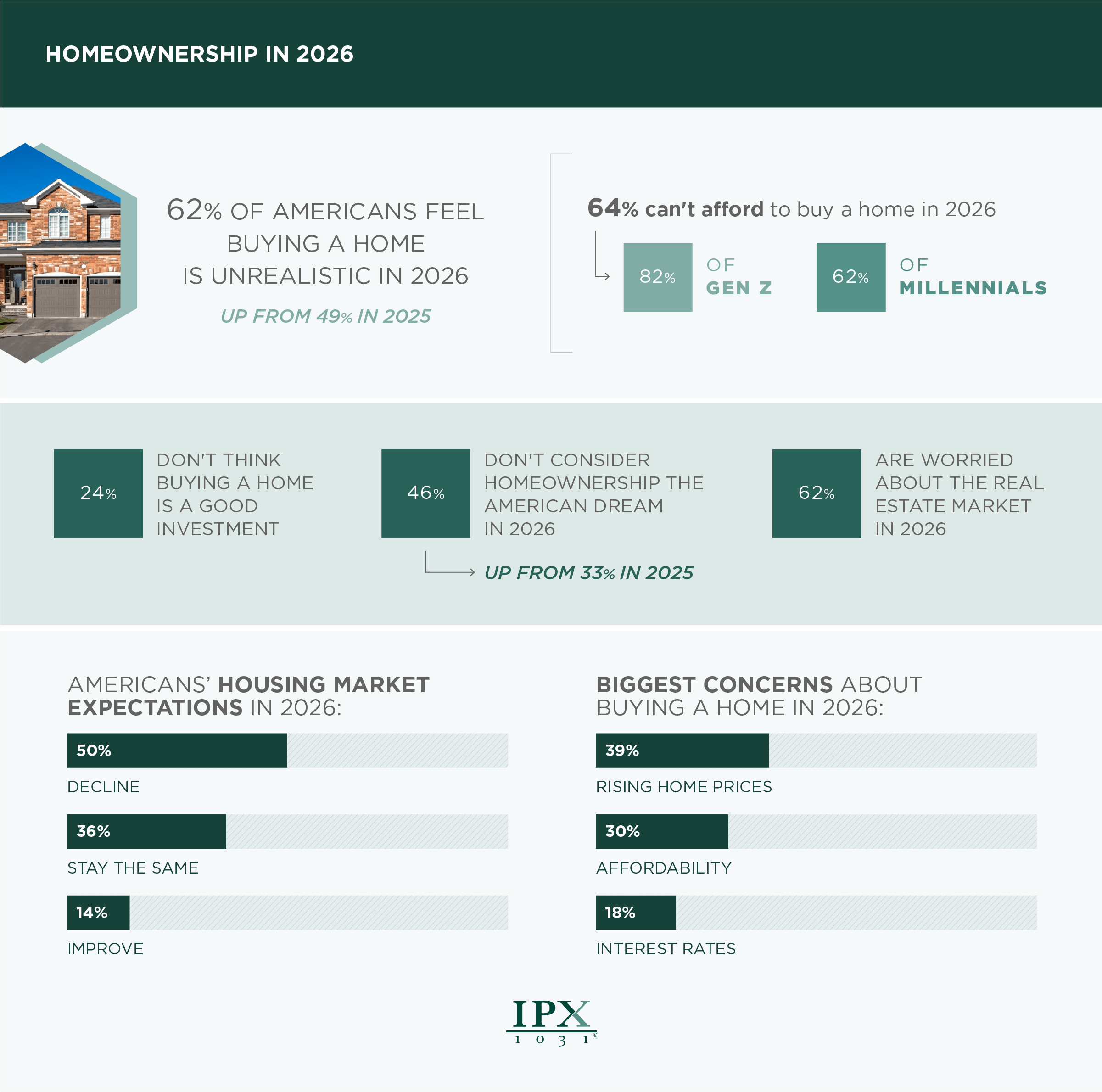
More than 3 in 5 (62%) Americans feel buying a home in 2026 is unrealistic. This is up significantly from 49% in our 2025 Homeowner Outlook report. Financial constraints play a major role: only 36% believe they can afford to buy a home, compared with 64% who say they cannot. When broken down by generation, 82% of Gen Z and 62% of Millennials say they can’t afford to buy a home this year. This may be why only 24% of Americans believe buying a home is a good investment.
Another notable shift in 2026: the number of people who don’t consider homeownership to be the American Dream is growing. Nearly half (46%) believe this, up from 33% in 2025. More than 2 in 5 are worried about the real estate market; half expect the market to decline, just over a third think conditions will stay the same, and only 14% anticipate improvements.
Americans’ Top Barriers to Buying a Home
Financial concerns dominate Americans’ hesitation to buy. The biggest obstacles are rising home prices (39%), affordability (30%), and interest rates (18%). Other anxieties, including market instability, career uncertainty, tax rates, and limited inventory, were each reported by fewer than 5% of respondents.
Stuck on the Sidelines: Homebuyers Waiting for Better Conditions
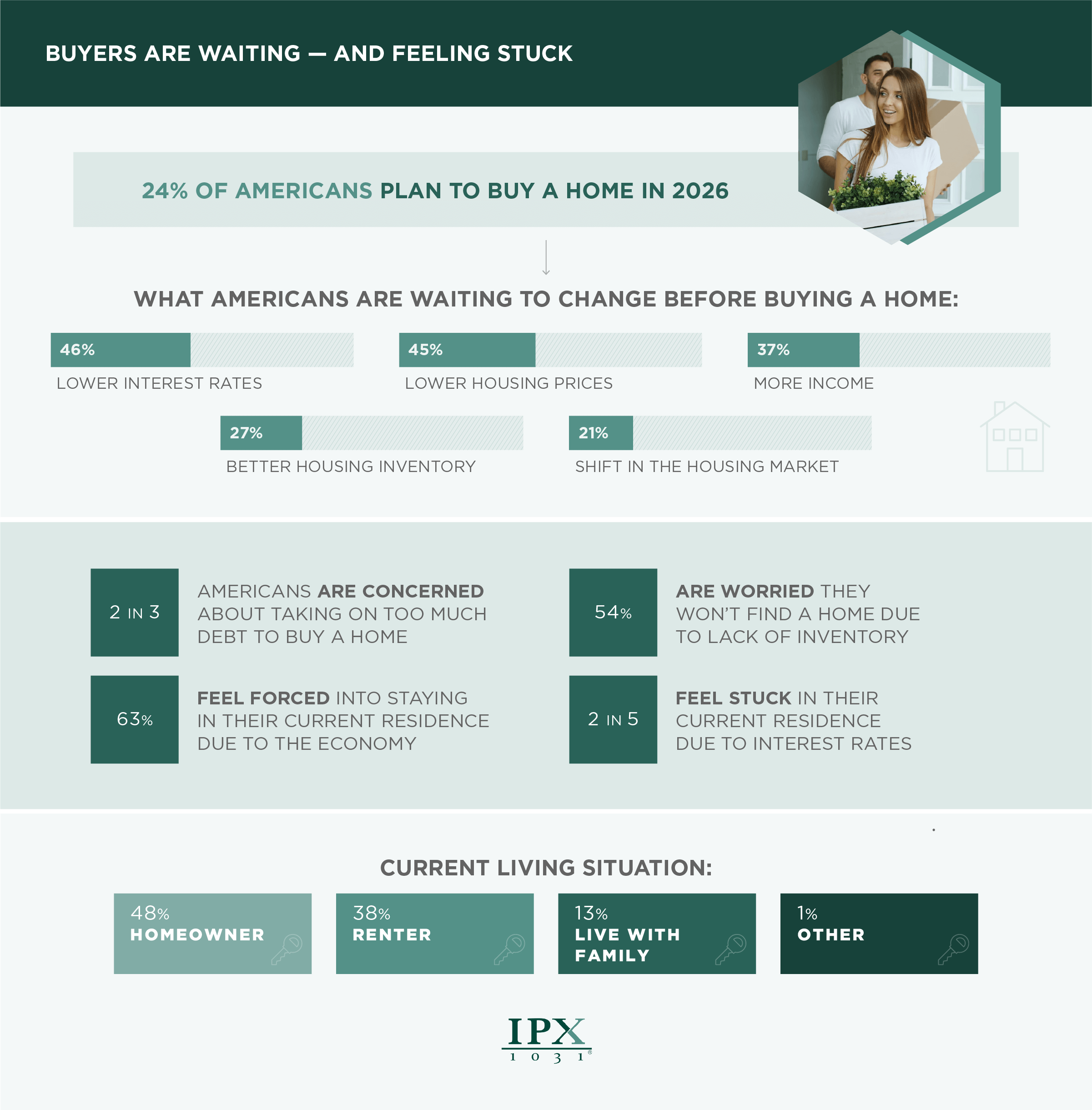
Despite the cultural significance of buying a home, only 24% of Americans plan to purchase a home in 2026. Rather than entering the market immediately, many Americans are in a holding pattern, waiting for conditions to improve. Nearly half are waiting for lower interest rates (46%), and a similar share is hoping for lower housing prices (45%). Others are looking for more income (37%), better inventory (27%), or a broader market shift (21%).
The emotional weight of this hesitation is clear: 2 in 3 worry about taking on too much debt, 54% are concerned they won’t find a home due to limited inventory, and 63% feel trapped by the broader economy.
Nearly half of respondents (48%) own their homes, while 38% rent, 13% live with family, and 1% report another living arrangement. Among homeowners, hesitation to move is common as 41% say high interest rates have led them to view their current house as a forever home.
How Americans Are Planning and Adapting for Homeownership
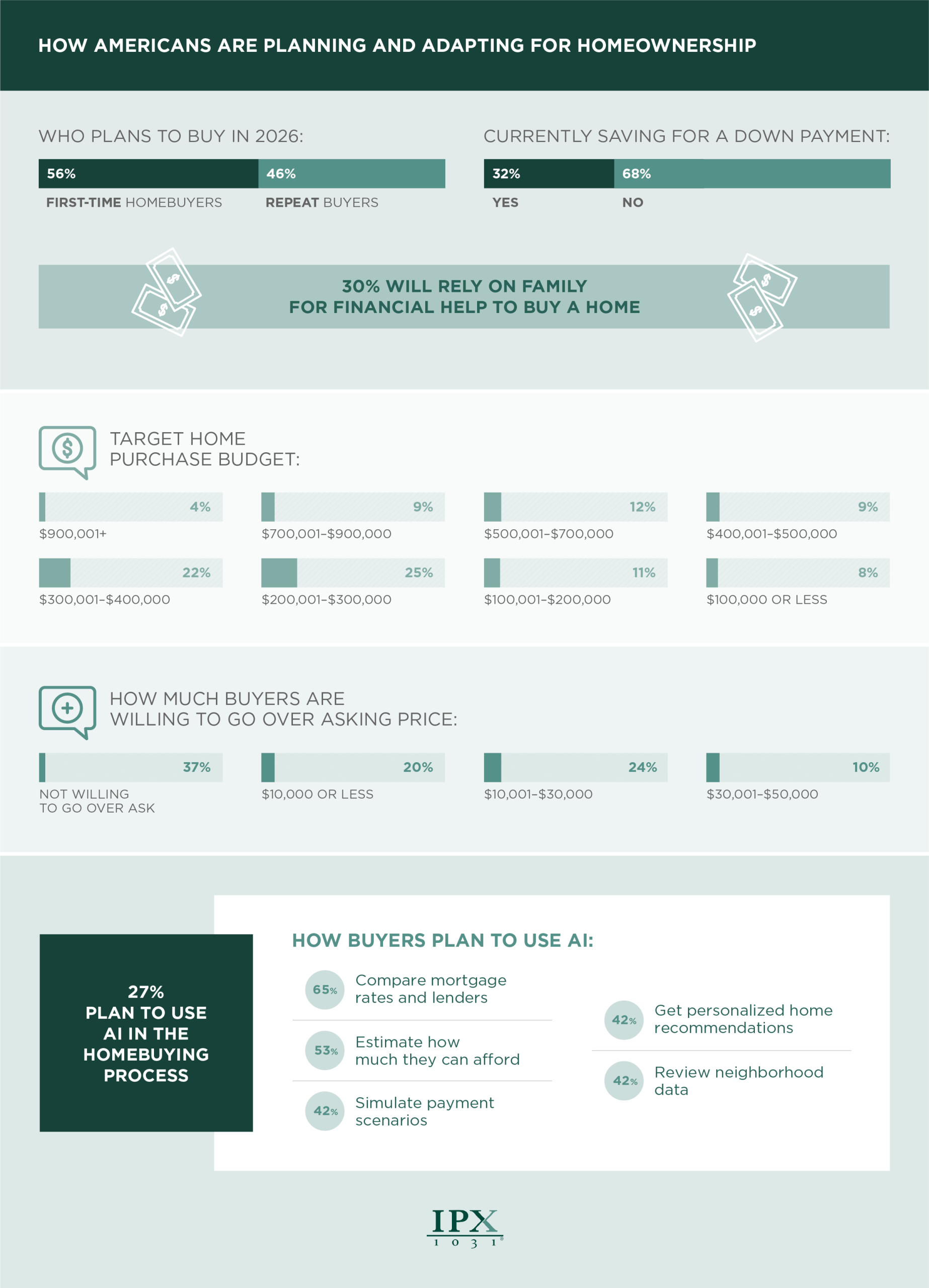
Among those still determined to buy in 2026, 54% are first-time homebuyers and 46% are repeat buyers. Many acknowledge they will need financial support, with 30% expecting help from family. Saving remains a challenge, with only 32% actively putting money aside for a down payment. This cautious approach contrasts with findings from the 2025 Homebuyers Report, which showed that many buyers in 2025 felt urgency to buy sooner.
Most 2026 buyers are targeting mid-range home prices:
- $100,000 or less – 8%
- $100,001–$200,000 – 11%
- $200,001–$300,000 – 25%
- $300,001–$400,000 – 22%
- $400,001–$500,000 – 9%
- $500,001–$700,000 – 12%
- $700,001–$900,000 – 9%
- $900,001+ – 4%
While competitive bidding has been a feature of recent housing markets, many buyers are exercising restraint. Over a third (37%) say they are not willing to go over the asking price, while others (34%) would pay $10,001 or more above the listed amount.
Many Americans will also be enlisting the help of artificial intelligence during their homebuying process. More than 1 in 4 (27%) Americans plan to use it. The top ways Americans will use AI in the homebuying process include comparing mortgage rates and lenders (65%), estimating how much they can afford (53%), simulating payment scenarios (42%), getting personalized home recommendations (42%), and reviewing neighborhood data (42%).
Are you planning to buy or sell real estate in 2026? Learn about how a 1031 Exchange can help preserve your assets when buying and selling investment properties. Investors thinking about converting a primary residence into a rental property can learn more about how a 1031 Exchange can help in that process. Learn more about Investment Property Exchange Services, Inc. (IPX1031), the nation’s largest 1031 Exchange company.
Methodology
In December 2025, we conducted a survey of 1,003 U.S. adults about their thoughts on home buying in 2026. Among respondents, 49% were female and 50% male with an average age of 41.
For media inquiries, contact media@digitalthirdcoast.net
Fair Use
When using this data and research, please attribute by linking to this study and citing IPX1031.
Read more:
Homeownership Statistics & Data: America’s Plans & Concerns for 2025
Homeownership Data 2024: Americans’ Concerns on Housing Affordability
Converting a Principal Residence to Minimize Taxes by Combining IRC §1031 and §121
Where the Vacation Home Market Has Grown the Most
How to Buy Your Vacation Home with a 1031 Exchange
1031 Exchange and Defer? Or Sell and Pay Taxes?
Survey: Do Airbnb Guests Trust Their Hosts?
Best Large Cities to Buy Investment Property 2020